
La Crosse Previous Residents Sources
Different sources answer different parts of a La Crosse address question. The parcel card identifies the current legal unit. Deeds trace owners, while directories and census schedules help identify previous residents who may never have held title. Newspapers, tax records, permits, and maps then test the dates and explain gaps. Start with the source nearest the time in question, but keep the parcel number and legal description close at hand. Street numbers and printed forms can change; lot, block, subdivision, and parcel references are usually steadier.
| Source | Years It Covers | Where Held | What It Shows |
|---|---|---|---|
| Tapestry real-estate and tract index | June 1987 to present online | La Crosse County Register of Deeds | Grantor, grantee, document data, and an image lead |
| La Crosse city directories | 1866 to present in print; older run online | La Crosse Public Library Archives and Murphy Library | Occupants, work, household clues, and later address sections |
| County directories and rural routes | Selected runs from 1893 through 1984 | La Crosse Public Library Archives | Names and address leads beyond the city street grid |
| Federal census | Public schedules through 1950 under the 72-year rule | NARA, FamilySearch, and library resources | Household members, ages, birthplaces, work, and local geography |
| Newspapers and obituary index | Database runs include 1904 to 1977 and 1905 to 1963 | La Crosse Public Library resources | Deaths, relatives, moves, and public notices |
| Tax, permit, and map files | Complete local runs not stated | Library and city or county custodian | Taxpayer, building work, footprint, and date clues |
For a recent transfer, the county parcel record and Tapestry are the fastest pair. Earlier work moves to the Register of Deeds counter and local archives. For occupants rather than owners, choose a directory close to the target year, then compare it with a released census, obituary, or newspaper notice. An apparent match remains a lead until names, dates, and the address all agree.
Start With La Crosse Parcels
The La Crosse County real-property listing provides the modern anchor for a backward search. Save the current owner, mailing and parcel address, parcel number, tax year, and brief legal description. The county search accepts owner name, mailing or parcel address, parcel number, or tax-bill number. Use one field at a time. A parcel number must use the padded ##-#####-### form, so add zeroes when a shorter form fails.
The tax-mail address can point elsewhere. It does not prove that the owner lives at the parcel. The situs address identifies the land's physical place, while the legal description ties the parcel to a lot, block, subdivision, or metes-and-bounds description. Keep all three separate. For a City of La Crosse parcel, the city assessor may be the best fallback for a city-specific assessment question.
Note: Save the parcel card before searching old files, since owner names and tax-year displays can change after a later transfer.
La Crosse Deeds Before 1987
The online line is not the start of La Crosse land records. Tapestry's real-estate and tract indexes begin in June 1987, but older deeds, plats, books, and indexes remain with the county and archival sources. Once the backward chain reaches that month, take the last known party, recording reference, and legal description to the La Crosse County Register of Deeds. Genealogy research is by appointment Tuesday through Thursday from 9 a.m. to 3 p.m.
Tapestry costs $8.95 per search and returns no more than 200 listings. Narrow a common name by date, legal description, document number, or document type. Viewing an image is free; downloading or printing costs $2 for the first page and $1 for each added page. Those limits make a careful sequence far less costly than broad surname searches. The office counter, deed books, library, and archives form the fallback chain when the web index ends.
Insider tip. Treat June 1987 as an online access boundary, not as proof that an older La Crosse deed does not exist.
Walk La Crosse County Deeds Back
A deed chain follows each transfer in reverse. Start with today's parcel owner, then locate the deed by which that party acquired the same legal parcel. The seller on that deed is the prior owner. Search that seller as a buyer in an older period and repeat. Compare the legal description at every turn. Names alone are weak because spouses, trusts, companies, initials, and spelling variants can change while the land stays the same.
- Copy the present owner, parcel ID, and full legal description from the parcel record.
- Find the current owner's purchase in Tapestry as a grantee and open the deed detail or image.
- Record the grantor, date, document number, and legal description. Search that grantor as an earlier grantee.
- Repeat while the parcel description agrees. Test married names, initials, trusts, and business owners when needed.
- At the online cutoff, use the county's older index books, an office appointment, or archival help.
- Grantor and grantee
- The grantor transfers an interest; the grantee receives it.
- Chain of title
- The linked sequence of recorded transfers for the same parcel.
- Legal description
- The formal land description, often based on lot, block, subdivision, or measured boundaries.
- Criss-cross directory
- A directory arranged by street or address rather than only by a person's surname.
La Crosse Library House Research
The La Crosse Public Library property-history method joins parcel search, maps, city directories, an obituary index, newspapers, city tax records, and photographs. That set is useful when a deed names an owner but says little about who occupied the rooms. The Archives Research & Reference Room at 800 Main Street also has genealogy books, yearbooks, local public records, maps, and microfilmed census and vital material. Staff can help identify which source fits a missing year.
The library's published hours are Monday through Thursday from 9 a.m. to 8 p.m., Friday and Saturday from 9 a.m. to 5 p.m., and Sunday from 1 to 5 p.m. Confirm before a visit. The room can be reached at (608) 789-7136 or archives@lacrosselibrary.org. Newer bound directories stay onsite because of copyright, so an online miss should lead to the reading room, not to the claim that no directory exists.
The source page below shows the local workflow in its own setting.
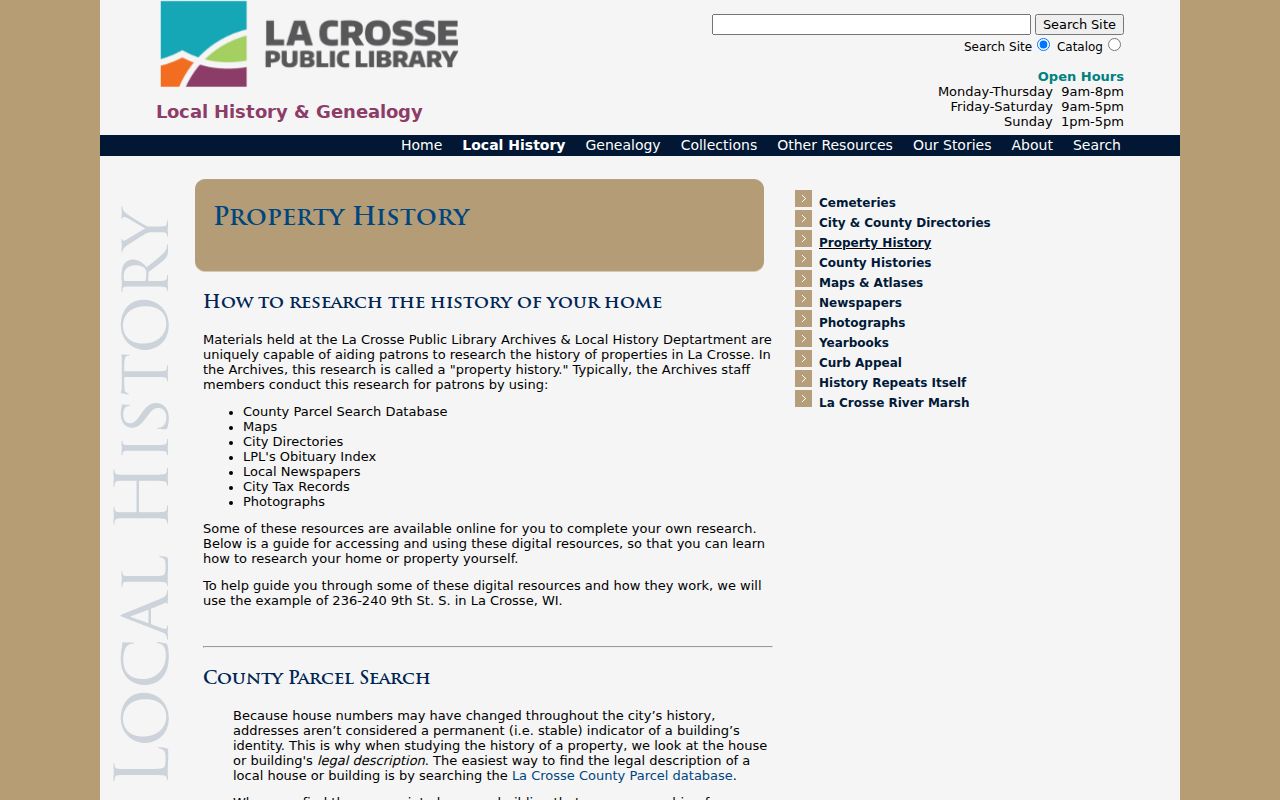
Its mix of parcel, map, directory, news, tax, and photo sources is the right model for checking previous residents.
When La Crosse Addresses Fail
Old directories do not behave like a modern address database. La Crosse's earliest volumes were arranged by surname. Address indexing appeared around 1903, and volumes after 1907 generally add a street section. Exact digital search can still miss punctuation, abbreviations, directional marks, and optical character recognition errors. An address such as 236-240 9th St. S. may not match the way it was typed into a search box.
Browse page images and use the library's address worksheet. If the number still fails, search the occupant's surname, the lot and block, an adjacent landmark, or the same street in the next directory year. Annexation and boundary changes may also alter the place name shown in a census or directory. No official local street-renumbering year was found in the research, so do not assume that a mismatch proves a renumbering event.
Note: A recorded legal description can bridge years when a street number, city label, or printed abbreviation no longer matches modern use.
A La Crosse Widow Clue
The library's teaching example at 236-240 9th Street South shows why names can change while the address does not. A 1907 directory page identifies Louisa Withee as the widow of Niram Withee. That small notation links a household identity to one place and suggests where an obituary, death record, probate file, or earlier directory may extend the trail.
Older directories rarely listed married women in their own right. The local archive notes that married women generally were not listed until 1922 unless they worked outside the home. Widows could appear under their own names. Therefore, an absent spouse is not proof that she had left La Crosse, and a new female household heading may mark a death rather than a sale or move.
Dating a La Crosse Property
Maps, tax files, permits, and photos can date a structure or change even when they do not identify every person who lived there. Sanborn fire-insurance maps can show building footprint, use, and lot context, but the complete La Crosse year run was not established in the research. City tax records may identify the taxpayer. Permit and code files may record construction, repair, or an applicant, although no current complete public permit-search interface or coverage start was located.
Ask the City of La Crosse planning or building custodian for the exact address, record type, and date range. A written request under Wisconsin Public Records Law gives the custodian a clear scope. Compare any map outline with a deed and parcel record. County GIS lines are useful research guides but may differ from imagery by about three feet, so they are not a survey or legal boundary decision.
La Crosse Past Household Layers
Owners are only half of an address history. Directories can show heads of household, adult members, work, phones, owner or renter marks, and widow notes, depending on edition. Census schedules supply a different snapshot of household ties, ages, birthplaces, and work. The La Crosse city directories are covered in depth with their publisher and access history; use those volumes here as yearly address evidence.
- Choose a directory year close to a released federal census year and find the address in its street section when available.
- Copy each spelling, initial, spouse or widow mark, occupation, phone, and directional suffix exactly as printed.
- Find the census household by name and geography. Remember that the census is a point-in-time count, not an annual roll.
- Move one directory at a time in both directions to see arrivals, departures, and changed household headings.
- Use obituaries, cemetery sources, probate, and deeds to test deaths, relatives, heirs, and ownership.
La Crosse Tribune access through the library includes NewspaperArchive material from 1904 to 1977 and a Newspapers.com or BadgerLink run from 1905 to 1963, subject to card rules. An obituary is a strong trail endpoint because it may name relatives and a former address, but it should still be checked against the directory or official record.
Lawful use. Research previous residents for La Crosse house history, genealogy, or personal curiosity. Never use an address trail to watch, harass, or harm a living person.