
La Crosse Directory Collections
La Crosse has an unusually long directory record. The first known volume dates to 1866. The La Crosse Public Library Archives reports print city directories from 1866 to the present, with older public-domain runs online. Its property-history material describes bound copies through 2020. UW-La Crosse Murphy Library Special Collections also holds a complete paper set.
| Collection | Years | Where Held | Access |
|---|---|---|---|
| City directories | 1866-present in print | LPLA Archives and Murphy Library | Older volumes online; newer bound volumes onsite |
| County directories | 1901, 1906, 1940-1984 semiannually | LPLA Archives | Onsite |
| Rural-route lists | 1893, 1895, 1932-1969 | LPLA directory volumes | Online or onsite by edition |
| Local newspapers | 1904-1977 and 1905-1963 database runs | LPLA links | Library-card terms vary |
| Census and vital microfilm | Runs vary | LPLA research room | Onsite with staff help |
Online coverage is narrower than the shelf because copyright keeps newer editions in the reading room. One current archive page describes digitized volumes through 1963, while an older article ended its online range in 1924. Use the current catalog and viewer. Do not assume that a missing online year means the library lacks the volume.
The city and county runs solve different geographic problems. A city book follows urban names and addresses. County volumes and rural-route lists reach communities outside the incorporated grid. Record the collection title as well as the year, since two books from a similar date can cover different places and may sort entries in different ways.
La Crosse Directory Publishers
Publisher names help identify an edition when a scan has a vague file title. The La Crosse County Historical Society documents the local publishing sequence and explains the value of city directories. Names and dates changed often in the nineteenth century.
| 1866 | A. Bailey publishes the first known La Crosse directory |
|---|---|
| 1868 | F. A. Ketchum edition |
| 1870 | A. Brainerd edition |
| 1873 | Campbell & Davison edition |
| 1876 and 1878 | Pryor & Co. editions |
| 1911 edition | Wright Directory Company, published in 1910 |
Other names in local bibliographies include Spicer & Buschman and Philippi's Directory Company. Check the title page and abbreviation key before applying rules learned from another publisher.
The Historical Society's city directory collection page provides the publisher context shown in the captured source below.
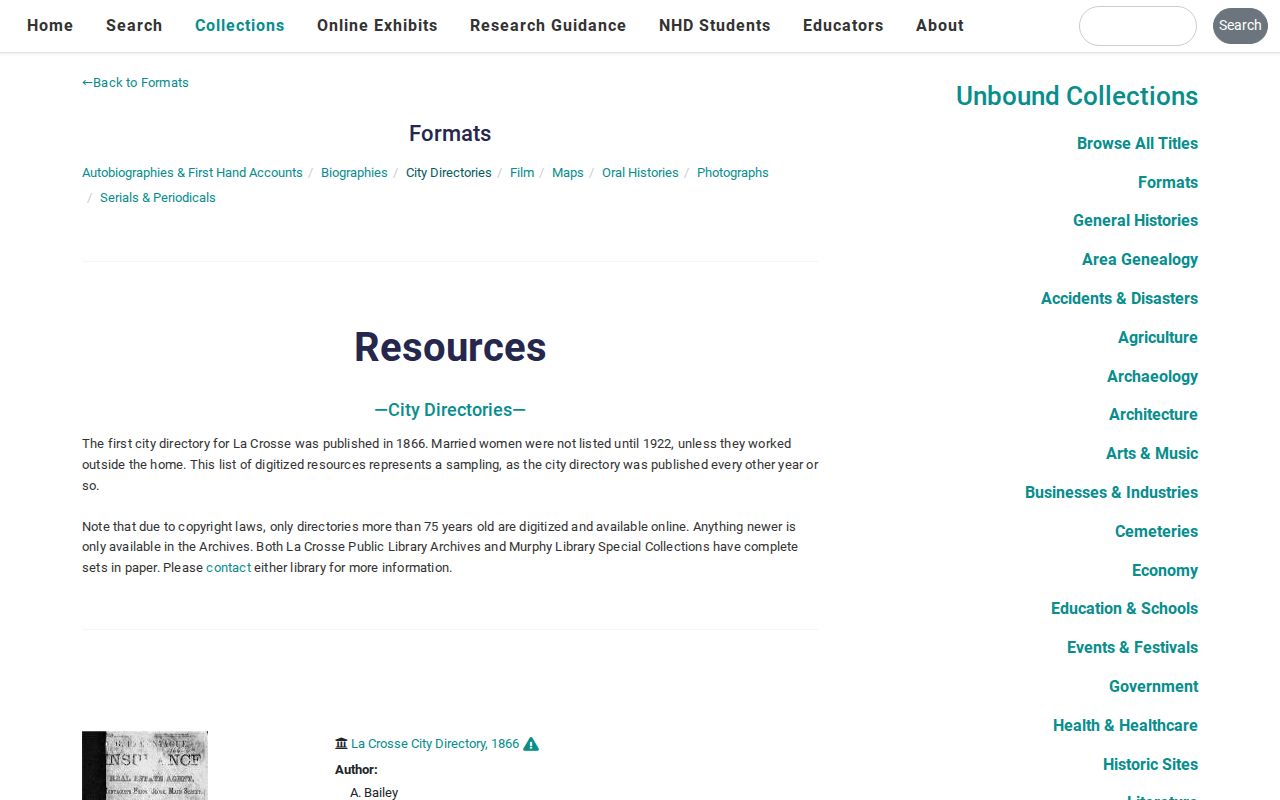
The collection screen helps tie each La Crosse city directory to its maker, which is essential when layout and abbreviation rules vary by edition.
The publisher sequence is more than a timeline. It warns against expecting one stable layout. A surname may be alphabetized differently, work may be shortened in a new way, and a street section may appear only in part of a volume. Save the title page with any copied entry so another researcher can identify the exact edition and test the reading.
Use La Crosse Directory Archives
The La Crosse Public Library Archives is the main city directory desk. Its Research & Reference Room is at 800 Main Street. Published hours are Monday through Thursday, 9 a.m. to 8 p.m.; Friday and Saturday, 9 a.m. to 5 p.m.; and Sunday, 1 to 5 p.m. Confirm before travel. Staff can be reached at 608-789-7136 or archives@lacrosselibrary.org.
The non-circulating collection also has maps, atlases, newspapers, photographs, yearbooks, cemetery material, local public records, genealogy books, and microfilmed census and vital records. Digital readers and staff help make it possible to move from one city directory entry to a richer family or property file.
The successful manifest image records the official directory holdings page. Review the library's collection description before the capture below.
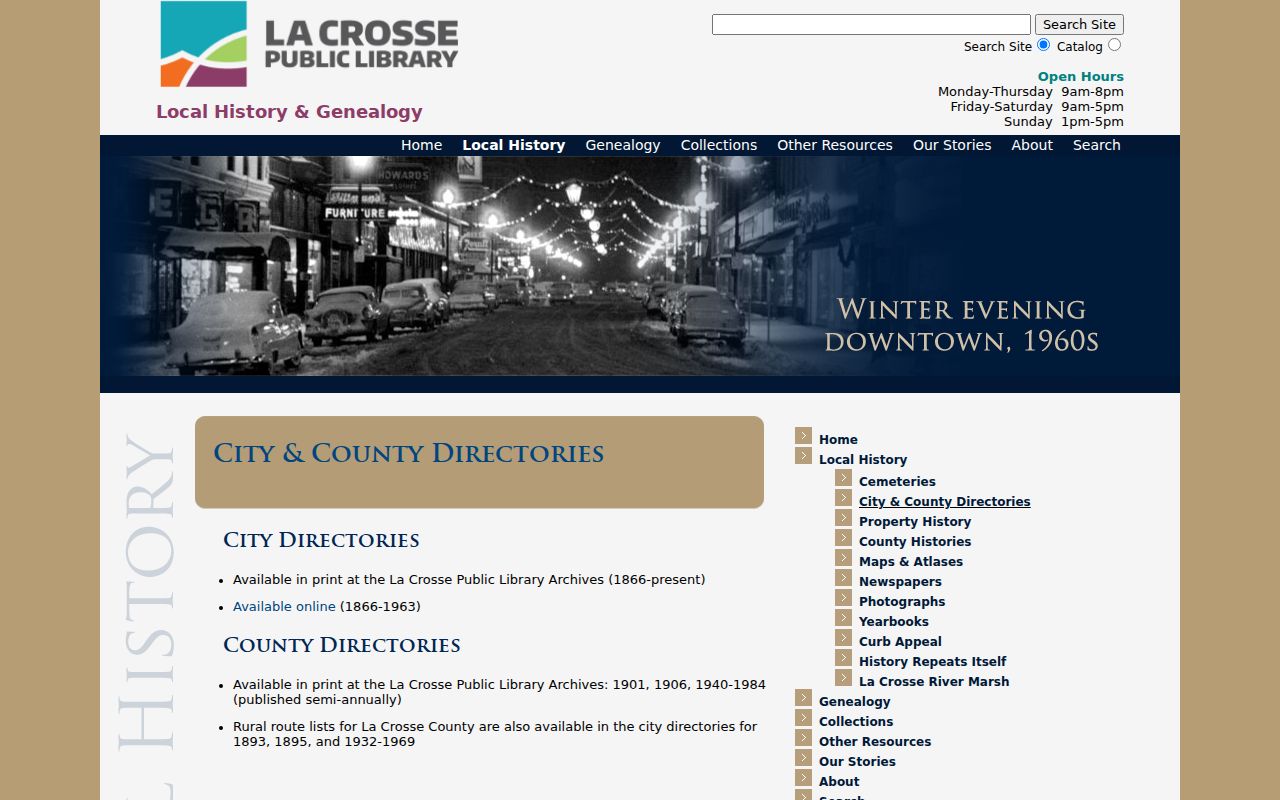
The page separates online older volumes from the much longer print shelf, a key access distinction for current research.
Read a La Crosse Directory Entry
An early La Crosse city directory usually names the head of household, street address, and occupation, sometimes with an employer. Later books may add a spouse, adult household members, telephone number, or ownership mark. Conventions change by year. Read the key printed in the same volume before expanding any letter or symbol.
| Name | Head of household or listed adult; spelling and initials vary |
|---|---|
| Spouse | May appear in parentheses in later editions |
| Occupation | Trade and sometimes an employer |
| Address | House number, street, directional suffix, or rural route |
| Ownership marker | Edition-specific symbol that must be checked in the key |
| Widow notation | May name a deceased spouse and explain a household-name change |
- Criss-cross directory
- The street-order part of a later directory, arranged by address rather than name.
- Householder index
- An address-based list of household heads or principal occupants.
- Abbreviation key
- The edition's own guide to short forms, occupations, and status marks.
Married women were generally not listed until 1922 unless they worked outside the home. Their absence should not be read as absence from the household.
Inside the 1911 La Crosse Directory
The digitized Wright's Directory of La Crosse for 1911 is a useful model. Its metadata names Wright Directory Co. of Milwaukee, gives a 1910 publication date, and identifies general citizen, classified business, and complete street sections. Public-domain status allows online page viewing.
The manifest capture shows the official metadata and viewer. Open the linked source first, then compare the screen below with the title page and page images.
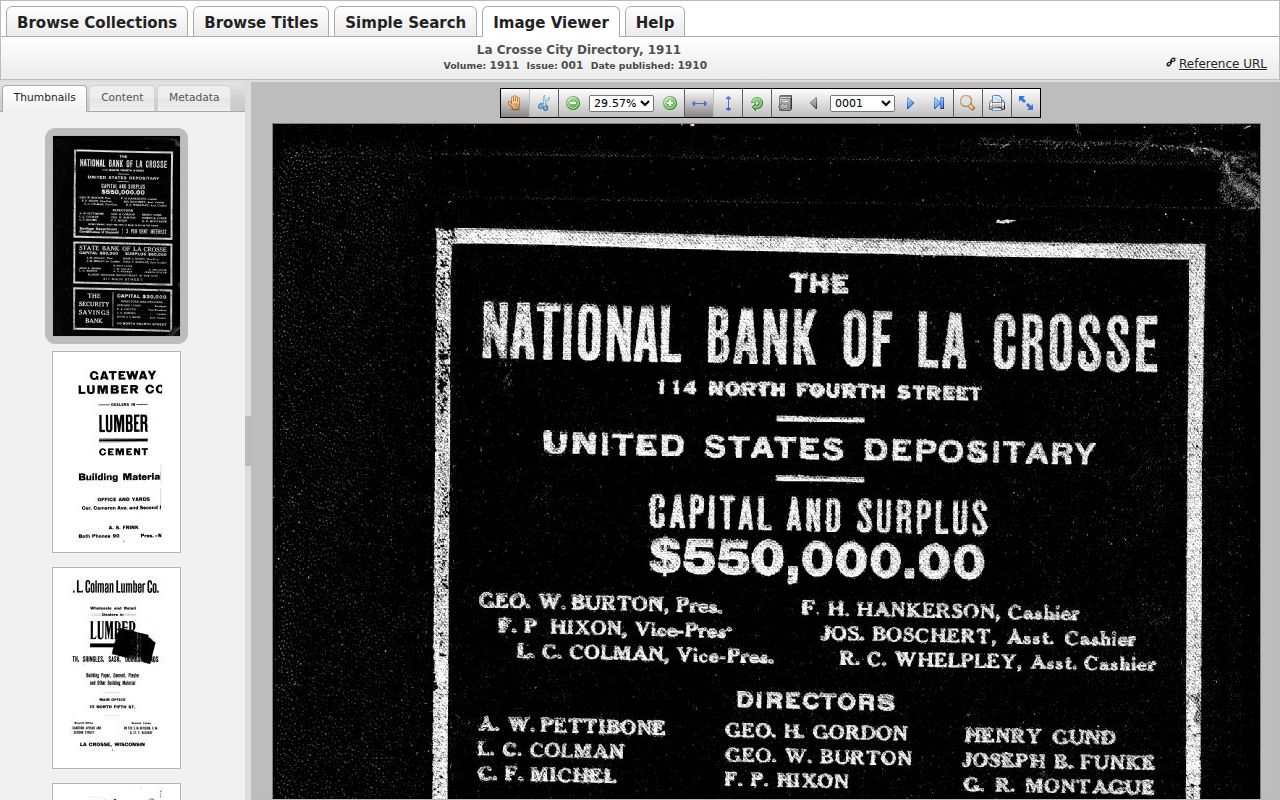
The three-part structure lets a researcher move between a surname, a trade, and an address without treating any one section as a complete population roll.
La Crosse Adds Street Sections
Address research changes around the start of the twentieth century. The library worksheet says city directories lacked an address index until 1903. Its property-history guide says pre-1907 books were organized only by last name, while later volumes generally add a section arranged by address. These are transition markers, not a promise about every edition.
Exact OCR searches can miss punctuation, number ranges, and abbreviated directions. An address printed as “236-240 9th St S” may not match the wording typed into the search box. Browse nearby page images and try the surname section. For a modern parcel-first method, use the La Crosse street directory.
Note: Photograph or save the abbreviation key with each entry because the same letter may carry a different meaning in another edition.
Louisa Withee's La Crosse Directory
The library's property-history guide uses 236-240 9th Street South as a teaching example. A 1907 entry identifies Louisa Withee as the widow of Niram Withee. The notation explains why a household at one address may appear under a different given name from one year to the next.
This example also shows why older city directories underrepresent women. A widow may receive her own entry, while a married woman may be absent unless employed outside the home. The record reflects publication practice, not the full household.
Extend La Crosse Directory Research
A directory entry is stronger when paired with a record made for a different reason. LPLA links La Crosse Tribune material through NewspaperArchive for 1904-1977 and Newspapers.com or BadgerLink for 1905-1963, subject to card rules. Its obituary index and genealogy database can supply dates and relatives. Maps, tax records, and photographs help test an address.
Yearbooks may help reconnect classmates or distinguish two people with the same initials. Federal census schedules describe household relationships that an early city directory omits, though recent schedules follow a 72-year release rule. Rural-route lists in selected La Crosse editions cover people outside the modern city grid.
Beyond La Crosse City Streets
The Coulee Region's bluffs, river corridors, valleys, and rural routes complicate place names. A person associated with La Crosse may appear under a township, route number, nearby valley, or county directory rather than the incorporated city street expected today. The county volumes from 1901 and 1906, the semiannual 1940-1984 run, and rural-route lists can restore that wider context.
Modern postal labels should not be projected backward. The Mississippi, Black, and La Crosse rivers shaped roads and settlement, while later postal and civic boundaries serve other purposes. Compare the directory wording with a map or atlas from the same period. The LPLA map and photo collections can help place a route or institution that no longer carries the same name.
Local organization files also add context without acting as resident rolls. School yearbooks, university archives, cemetery sources, and newspapers may distinguish people who share a surname. Ask LPLA or Murphy Library staff to identify a verified holding before assuming a church, veterans group, or other organization preserved a usable roster.
Trace La Crosse Directory Families
Follow one household across consecutive volumes instead of jumping between distant years. Record exactly what the entry says, including initials, spelling, spouse or widow marker, work, address, and direction. A city directory captures one publication cycle, while a census captures a household at enumeration time.
- Find the first likely surname entry and copy every detail without silently expanding abbreviations.
- Move one edition forward and backward. Note a new address, spouse, occupation, or disappearance.
- When available, check the street section to see who else is listed at the address.
- Compare nearby federal census years for ages, relationships, and household members omitted by the directory.
- Use an obituary, newspaper, cemetery record, probate file, or deed to explain the final change.
A disappearance may mean death, a move, a missed canvass, changed spelling, or a listing under another household head. Do not choose one explanation from the gap alone. The library's local sources and the Register of Deeds genealogy appointments provide offline fallbacks when a needed volume or land record is not online.
Register of Deeds genealogy work is by appointment Tuesday through Thursday from 9 a.m. to 3 p.m. That schedule differs from the regular office hours and the counter cutoff for vital-record applications. Call before visiting. Bring names, date ranges, and known addresses so staff can direct the search to deeds, historical vital material, or the right index rather than beginning with an open-ended family request.