
Find La Crosse Residents
Begin with the fact that is least likely to be wrong. An exact street address belongs in the county parcel search. A full name can be checked in the owner roll, the Wisconsin court index, MyVote, or a historic directory, depending on the purpose and time period. For a phone number, the search box can provide a lead, but an official record should confirm any identity. La Crosse is both a city and the county seat. That matters because city records, county land files, and statewide indexes are held by different custodians.
No official roll is a complete list of everyone living in a home. Parcel data usually names an owner, not every occupant. MyVote is designed for a voter to check registration and polling information, not to publish a household directory. Court data covers parties in cases, and a historic volume reflects only its publication year. The best resident search therefore builds a small chain of consistent facts.
- Check the La Crosse County parcel search by one owner, address, parcel, or tax-bill field.
- Use MyVote Wisconsin for the registration and polling details it permits.
- Search Tapestry by name or legal description when a deed link is needed.
- For an older household, consult the public library's printed and scanned city directories.
- Send a narrow written request to the city or county custodian when a needed record is not online.
A useful cross-check joins a person to both a place and a date. Matching only a name is weak proof, especially when initials or common surnames repeat. Record the source, search date, and exact spelling so the route can be repeated.
The search route changes when the starting point is an era. A present-day address can move from the parcel card to a deed. A name from the early twentieth century is more likely to yield a useful city-directory entry, obituary, census line, or newspaper mention. When only a business name is known, Wisconsin's corporate index may expose a registered agent or office, but that public business address is not proof of where the person lives.
La Crosse Resident Record Keepers
Three county desks form the core of a La Crosse residents directory search. The Register of Deeds preserves recorded land instruments and local vital records. Land Information maintains parcel numbers, ownership and mailing addresses, legal descriptions, tax bills, and assessment rolls. The County Clerk handles elections and points voters toward the state lookup. City parcels may also require the City of La Crosse assessor, so confirm the jurisdiction before treating a county result as final.
La Crosse County Register of Deeds
212 6th Street North, Room 1400
La Crosse, WI 54601
608-785-9644 or 608-785-9645
County Land Information
212 6th Street North
La Crosse, WI 54601
Use the county department contact listing
La Crosse County Clerk
212 6th Street North
La Crosse, WI 54601
608-785-9581
Counter access remains important in La Crosse. The Register of Deeds is open Monday through Friday from 8 a.m. to 4:30 p.m., with a 3:30 p.m. recording cutoff. Vital applications are accepted until 4 p.m. Genealogy appointments run Tuesday through Thursday from 9 a.m. to 3 p.m. These separate clocks reflect separate tasks, so confirm the service and time before traveling to 212 6th Street North.
For circuit matters, the local court is in Wisconsin's 7th Judicial District. The clerk at 333 Vine Street holds the official file even when a WCCA summary is visible online. Municipal citations may instead stay with the city clerk or municipal court. Asking which level heard the matter prevents a search of the wrong index.
La Crosse Parcel Search Fields
The county parcel portal is the most direct current ownership tool. It accepts one field at a time, a small rule that prevents many failed searches. Owner mailing address and the parcel's physical address can differ. A parcel is a mapped unit of land, and its situs address is the street location assigned to that unit.
| Search field | Use | Local format note |
|---|---|---|
| Owner name | Find parcels tied to the current assessed owner | Use alone |
| Mailing or parcel address | Match an owner mailing address or site address | Do not combine with another field |
| Parcel number | Open one mapped tax parcel | Use ##-#####-### and pad short numbers with zeroes |
| Tax-bill number | Reach the matching bill record | Try the current tax year if missing |
The La Crosse County property-search instructions show where to begin. The captured county screen below helps identify the correct public entry point before entering an address.
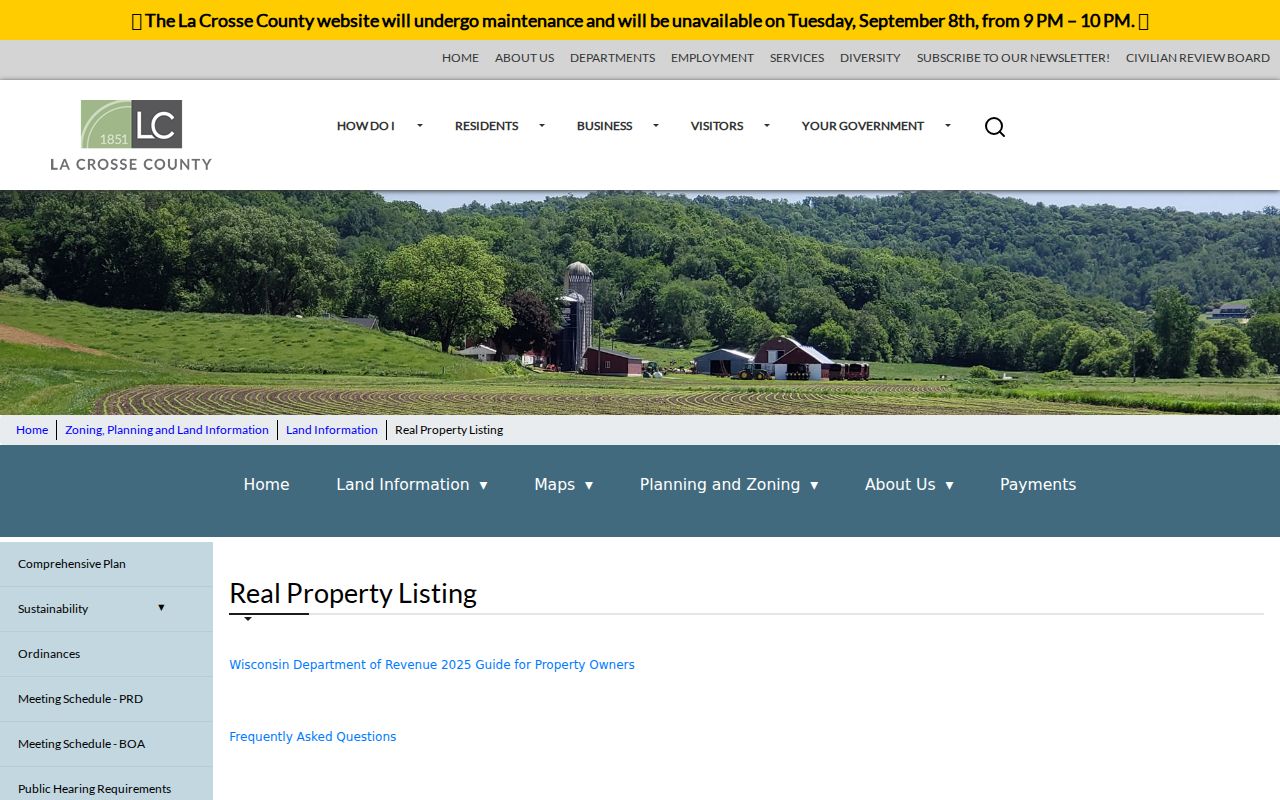
The result can supply an owner name, mailing address, brief legal description, school or special-district codes, tax information, and assessment data. Follow city-parcel notices if the county directs the search to the municipal assessor.
The companion GIS portal offers Parcels, Zoning, and Public Land Survey System applications. A parcel popup can show owner and mailing fields, acreage, tax data, assessment values, legal-description text, zoning, municipality, school district, and links to related material. Map lines are approximate. The county warns that parcel geometry may be about three feet from the true line, so a GIS view is a search aid rather than a survey.
If an address fails, strip the query down to one field and verify the municipality. The owner's mailing address may be outside La Crosse while the land is inside it. Condominiums and multi-unit property can also have several tax parcels tied to what looks like one street address. The parcel number is the most stable bridge to deeds, maps, and tax records.
La Crosse Deed Index Limits
Tapestry carries the county real-estate index and tract index from June 1987 forward. Search modes include a name, legal description, document number, date range, and document type. The $8.95 search charge returns no more than 200 listings. Record detail and image viewing are free, while downloading or printing costs $2 for the first page and $1 for each added page.
The date is an online cutoff, not the birth of the record series. Older deeds, plats, and books remain with the Register of Deeds, county archive, library, or historical society. Call before a visit. Genealogy research at the office is by appointment Tuesday through Thursday from 9 a.m. to 3 p.m., while its land-recording cutoff and vital-copy counter have different daily times.
A deed index entry is a pointer, not the whole transaction. The grantor is the party transferring an interest, while the grantee receives it. The instrument date, recording date, document number, and legal description help distinguish two people with similar names. A tract search follows the land description rather than a street label, which is useful when an address changed or had not yet been assigned.
Three online access options are advertised from the Register of Deeds landing page, and vendor links may change. For a broad name with more than 200 hits, divide the search into short date ranges. For an item before June 1987, give office staff the known owner, approximate year, and legal description. That makes a counter or archive search far more precise.
Wisconsin Records Requests in La Crosse
Wisconsin Public Records Law, Wis. Stat. §§19.31-19.39, provides the fallback when a La Crosse record is public but not searchable online. Direct the request to the agency that made or keeps the item. For a city permit, that may be building or planning staff. A county deed belongs with the Register of Deeds, and the circuit court clerk keeps the official court file.
A practical request states the address or name, record type, date range, and desired format. Ask about copy charges and legal redactions before ordering a large file. A phone call can identify the right custodian, but a written request preserves the exact scope. The city clerk, assessor, municipal court, cemetery office, and county offices do not share one universal search screen.
City records add detail that county rolls may not carry. The City Clerk keeps ordinances, council records, petitions, licenses, and public requests. Building and planning staff hold permits, zoning, code, and development files keyed to an address. Research did not locate a current public permit-search field list or municipal-court fee schedule. The correct route is therefore a request naming the street address, type of permit or case, and the time span.
Current La Crosse Resident Directories
Modern directory-like sources each describe only a defined group. Property rolls name assessed owners. The deed index names parties to recorded instruments. MyVote lets a voter verify registration details, while WCCA shows public case information about named parties. Neighborhood pages publish civic contacts and borders, not household membership. Read each roll according to what its keeper collected.
| Source | Who It Lists | Keeper | Access |
|---|---|---|---|
| Real Estate Tax Parcel Search | Assessed owners | County Land Information or city assessor | Free web portal |
| MyVote Wisconsin | The voter using the verification service | Wisconsin elections system | Free self-service lookup |
| Tapestry land index | Parties to recorded land documents | Register of Deeds | Paid search, free image view |
| WCCA | Parties in public court cases | Wisconsin court system | Free index and courthouse terminals |
| Neighborhood pages | Association board and civic contacts | City and associations | Free public pages |
Use the parcel roll for the owner of a place and WCCA for a court-party match. Use a La Crosse resident lookup when the aim is to verify one person across records. None of these sources proves that every named person still lives at the address shown.
Other public lists answer narrower questions. The county jail screen can show a current booking name, age, city and state, and arrest date, but it is not a record of guilt. Wisconsin's credential search can verify a license, while the Department of Financial Institutions corporate search returns entity and registered-office facts. A professional or registered agent may live elsewhere. These tools should corroborate a known identity, not create claims about a household.
Community contacts form a different layer. La Crosse publishes recognized neighborhood boundaries, meetings, and board contacts for areas such as Bluffside, Downtown, Grandview-Emerson, Hintgen, Holy Trinity-Longfellow, Springbrook-Clayton Johnson, and Washburn. They help identify the civic group serving a block. They are not lists of members or residents.
La Crosse Voter Record Boundaries
MyVote Wisconsin supplies registration, polling-place, and elected-official lookup functions. The public screen is meant for identity and address-based voter verification. A full Wisconsin voter file follows a separate statutory request and fee process, so it should not be confused with the MyVote form.
Address protection creates a sound gap. Wisconsin Safe at Home, authorized by Wis. Stat. §165.68, gives eligible participants a substitute address. Protected voters and legal redactions may block a location match. That absence should not be treated as proof that a person is unregistered or has left La Crosse.
Wisconsin also limits how motor-vehicle data can be disclosed. The state's DMV privacy process follows federal DPPA rules and Wisconsin chapter 343. An eligible person may use form MV3592 to withhold a name and address from files containing ten or more records, while permitted individual disclosures still exist. Driver-record Social Security numbers, photographs, medical data, and certain signatures are not ordinary public directory fields.
Verify La Crosse Court Names
The Wisconsin Circuit Court Access portal, often called WCCA or CCAP, publishes public case information from circuit courts. A result may show county, case number, caption, filing date, case type and status, party names, court events, charges, and disposition fields. The local official file remains with the La Crosse County Circuit Court in the Law Enforcement Center at 333 Vine Street.
A web result is not the full official file, and a case entry does not by itself prove identity or current residence. Compare middle initials, address context where lawfully available, dates, and county. Courthouse WCCA terminals are another access channel. Municipal matters may stay with the relevant city clerk or municipal court rather than appear as assumed in the statewide circuit index.
WCCA uses a CAPTCHA and limits automated or bulk access. Wisconsin courts also warn about paid services that claim they can remove court data but have no connection to the judicial system. When a result matters, note the case number and ask the clerk for the official file or an eligible copy. Court events, charges, and dispositions can change after an early search.
What does a booking prove? Only that the jail recorded a booking. It is not a conviction, and disposition must be checked through the court record.
La Crosse Vital Record Access
The La Crosse County Register of Deeds is the local custodian for county birth, death, marriage, domestic partnership, divorce, and military-discharge records. Wisconsin DHS Vital Records provides the statewide route. Applications may require identification, proof of eligibility, a completed form, and the correct fee.
Under Wis. Stat. §69.20-.22, births less than 100 years old and deaths less than 50 years old carry eligibility or tangible-interest limits. Recent marriage records also have limits. These certificates confirm events, not a live residents directory. For family research, the county offers genealogy appointments, and the library holds obituary and cemetery sources that can bridge a name between records.
Order forms identify the event, person, date and place, the applicant's relationship or legal interest, identification, delivery method, and signature. Exact eligibility depends on the record and its age. Confirm current Wisconsin DHS rules before sending payment. If a certificate is restricted, an older directory, newspaper notice, cemetery source, or public probate index may still provide a lawful family-history lead without exposing the certificate.
Official Rolls and Search Sites
Commercial people-search services collect data from many places, but their address links can be stale, merged, or assigned to the wrong person. Official custodians define what each record means and provide a way to request the source file. Cost alone does not decide quality: the county parcel portal is free, Tapestry charges per search, and certified vital copies have application rules.
| Source type | Best use | Main caution |
|---|---|---|
| Official index | Confirm a named event, parcel, filing, or registration | Coverage and redactions vary |
| Custodian copy | Obtain the authoritative record when eligible | Fees and access rules may apply |
| Commercial compiled search | Generate a lead from mixed public data | May be old, incomplete, or matched to the wrong person |
When an important detail conflicts, return to the office that keeps the record. Capture the case, parcel, or document number so staff can identify the same item.
La Crosse Directory Terms
Local search systems use a few terms in precise ways. Knowing them keeps a resident search from turning into a false match.
- Roll
- A list maintained for a set purpose, such as property assessment or voter administration.
- Index
- A finding aid that points to a source record; it may not contain the full document.
- Parcel
- A mapped unit of land with an assigned number and tax or assessment record.
- Criss-cross directory
- A directory arranged by street and house number instead of only by surname.
These sources overlap without being interchangeable. A parcel can exist without a directory entry, and an index name can identify a former owner rather than a current resident.
A legal description identifies land through recorded survey language, not just a postal street line. A certified copy is issued by the custodian as an official copy, while a plain portal image may serve only as a research copy. A docket records the events in a court case. Defining the term before drawing a conclusion reduces mistakes in a La Crosse resident search.
Historic La Crosse Resident Directories
The La Crosse Public Library Archives holds city directories in print from 1866 to the present-era and provides older runs online. The 1866 volume was the first local directory. Publishers included Alfred C. Bailey, A. Bailey, R. C. Clark, W. W. Williams, and later Wright Directory Company. Rural route lists appear in the 1893, 1895, and 1932-1969 directories, which helps when a family lived near the city grid.
A directory entry may give a resident's name, occupation, employer, spouse, widow status, and home address. Married women were often omitted from early volumes, while widows could appear under their own names. Later criss-cross sections let a reader start with an address. Before that arrangement, researchers must find a surname first, then follow the household across nearby years.
The library's Research and Reference Room is at 800 Main Street and can be reached at 608-789-7136 or archives@lacrosselibrary.org. It also holds maps, atlases, newspapers, photographs, yearbooks, cemetery material, and local organization records. The full shelf, sample entries, and publisher changes belong to the La Crosse city directory collections.
Published room hours are Monday through Thursday from 9 a.m. to 8 p.m., Friday and Saturday from 9 a.m. to 5 p.m., and Sunday from 1 to 5 p.m.; verify them before a visit. Home researchers may also use La Crosse Tribune material through NewspaperArchive for 1904-1977 with a City of La Crosse WRLS card, plus Newspapers.com through BadgerLink for 1905-1963 with Wisconsin resident card verification.
La Crosse House History Trail
The library's property-history method combines a current parcel result with maps, city directories, the obituary index, newspapers, city tax records, and photographs. Its teaching example follows 236-240 9th Street South and a 1907 entry for Louisa Withee, listed as a widow. The example shows why an occupant's surname can change even while the address trail remains useful.
Print directories and census schedules are snapshots made on different dates. Pairing them can establish who appeared at the address between census years, but neither proves uninterrupted residence. Keep spelling variants and street-number changes in the notes. La Crosse research did not locate an official street-renumbering year, so no date should be assumed.
The 1911 Wright volume illustrates the collection's depth. Its metadata credits Wright Directory Company of Milwaukee, gives a 1910 publication date, and identifies a general directory of citizens, classified business directory, and complete street directory. A scan can be read remotely, while staff and print volumes fill gaps caused by age, copyright, or poor indexing.
La Crosse Records Change Often
A public search is only as current as the source and its update cycle. The county advertises a free Property Fraud Alert for notice of new recording activity, but the alert does not prevent fraud or replace a deed review. Portal links, vendor screens, fees, and office hours can also change. Confirm them with the custodian before paying or traveling.
Save enough detail to repeat the search: exact names, date ranges, parcel or document numbers, and the office consulted. If a current portal yields nothing, move to the counter, courthouse terminal, library shelf, archive, phone call, or written request documented for that record set. That fallback chain is often the difference between no web result and a well-supported La Crosse resident record.
Fraud warnings are another reason to use official contact details. A deed-copy letter may charge far more than an office copy. An urgent caller may pretend to hold unclaimed money, demand payment for jury duty, or promise to erase a court record. Verify the claim with the published county, court, sheriff, or state number. Preserve the letter, number, web address, and payment instructions without forwarding private resident data.