
Find La Crosse Residents
One solid detail can unlock a surprising range of public records in La Crosse. Start with a name, an address, or a phone number. Then take it to the office that keeps that kind of file. The La Crosse residents directory works by matching what you already know to the right custodian. No single index holds every answer. County parcel rolls tie owners to land, and state voter and court tools confirm identity. The public library's old directory volumes preserve names from earlier generations. It can even help you find who lives on a street in La Crosse. That works by pairing a parcel record with a street address. Every source has gaps, though. A careful search checks two records against each other. It also calls the records office when the web falls short.
- Check the La Crosse County parcel search by one owner, address, parcel, or tax-bill field.
- Use MyVote Wisconsin for the registration and polling details it permits.
- Search Tapestry by name or legal description when a deed link is needed.
- For an older household, consult the public library's printed and scanned city directories.
- Send a narrow written request to the city or county custodian when a needed record is not online.
A good cross-check ties a person to both a place and a date. Names alone prove little, especially with common surnames or initials. Record the source, the spelling, and when you searched, so the route can be repeated.
The route also shifts with the era you start from. A present-day address can move from the parcel card to the deed that transferred it. An early twentieth-century name is likelier to surface in a city-directory entry, an obituary, a census line, or a newspaper mention. Sometimes only a business name is known. Wisconsin's corporate index may then reveal a registered agent or office, though that public business address is not proof of where the person actually lives.
La Crosse Resident Record Keepers
Three county desks anchor a La Crosse residents directory search. The Register of Deeds preserves recorded land instruments and local vital records. Land Information keeps parcel numbers, ownership and mailing addresses, legal descriptions, tax bills, and assessment rolls. The County Clerk runs elections and points voters to the state lookup. City parcels may still need the City of La Crosse assessor, so confirm the jurisdiction before treating any county result as final.
La Crosse County Register of Deeds
212 6th Street North, Room 1400
La Crosse, WI 54601
608-785-9644 or 608-785-9645
County Land Information
212 6th Street North
La Crosse, WI 54601
Use the county department contact listing
La Crosse County Clerk
212 6th Street North
La Crosse, WI 54601
608-785-9581
Counter hours still matter in La Crosse. The Register of Deeds is open Monday through Friday from 8 a.m. to 4:30 p.m. There is a 3:30 p.m. recording cutoff, and vital applications are accepted until 4 p.m. Genealogy appointments run Tuesday through Thursday from 9 a.m. to 3 p.m. Each service keeps its own clock. Confirm the task and time before traveling to 212 6th Street North.
Circuit matters belong to Wisconsin's 7th Judicial District. The clerk at 333 Vine Street holds the official file. A WCCA summary may appear online, but the file is the official one. Municipal citations may sit instead with the city clerk or municipal court. Ask which level heard the matter first, and you avoid searching the wrong index.
La Crosse Parcel Search Fields
The county parcel portal is the most direct tool for current ownership. It takes one field at a time. This small rule spares you many failed searches. Keep in mind that the owner's mailing address and the parcel's physical address can differ. A parcel is a mapped unit of land. Its situs address is the street location assigned to that unit.
| Search field | Use | Local format note |
|---|---|---|
| Owner name | Find parcels tied to the current assessed owner | Use alone |
| Mailing or parcel address | Match an owner mailing address or site address | Do not combine with another field |
| Parcel number | Open one mapped tax parcel | Use ##-#####-### and pad short numbers with zeroes |
| Tax-bill number | Reach the matching bill record | Try the current tax year if missing |
The La Crosse County property-search instructions show where to begin. The county screen displayed here helps identify the correct public entry point before you type an address.
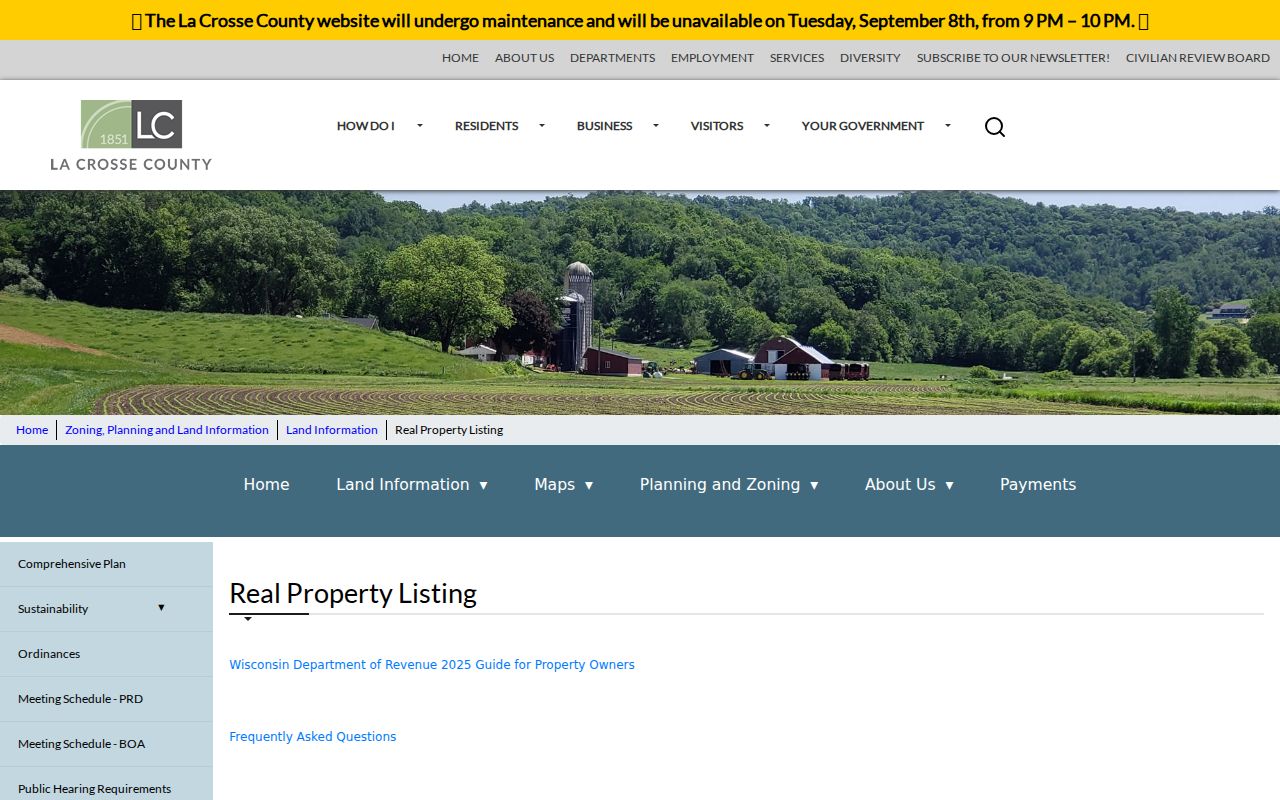
A parcel result can yield an owner name. It may also give a mailing address, a brief legal description, school or special-district codes, tax information, and assessment data. Follow any county notice directing city parcels to the municipal assessor.
The companion GIS portal offers Parcels, Zoning, and Public Land Survey System applications. A parcel popup can show owner and mailing fields. It can also give acreage, tax data, assessment values, legal-description text, zoning, municipality, school district, and links to related material. Map lines are approximate. The county warns that parcel geometry may sit about three feet from the true line. So treat a GIS view as a search aid rather than a survey.
When an address fails, strip the query to one field and verify the municipality. An owner's mailing address can lie outside La Crosse while the land sits inside it. Condominiums and multi-unit properties can also carry several tax parcels. They hide behind what looks like one street address. The parcel number is the most stable bridge to deeds, maps, and tax records.
La Crosse Deed Index Limits
La Crosse County puts its real-estate index and tract index online through Tapestry. It covers June 1987 forward. You can search by name, legal description, document number, date range, or document type. Each search costs $8.95 and returns at most 200 listings. Viewing record detail and images is free. But downloading or printing runs $2 for the first page and $1 per page after that.
June 1987 is only the online cutoff. The older deed books and plats still exist at the Register of Deeds. Copies also survive at the county archive, the library, or the historical society. Call ahead before visiting. Genealogy appointments at the office run Tuesday through Thursday, 9 a.m. to 3 p.m. The land-recording cutoff and vital-copy counter keep their own daily hours.
A deed index entry is a pointer, not the whole transaction. The grantor gives up an interest in the land. The grantee receives it. Instrument date, recording date, document number, and legal description let you separate two people who share a name. A tract search follows the land description instead of a street label. That helps when an address changed or never existed yet.
The Register of Deeds landing page advertises three online access options, and vendor links can shift over time. A common surname that tops 200 hits works better broken into short date ranges. For anything before June 1987, give staff the known owner, an approximate year, and the legal description. That turns a counter or archive search into something far more precise.
Wisconsin Records Requests in La Crosse
The Wisconsin Public Records Law, Wis. Stat. §§19.31-19.39, covers a La Crosse record that is public but lacks an online search. It serves as the fallback. Send the request to the agency that keeps the item. A city permit sits with building or planning staff. A county deed belongs to the Register of Deeds. The circuit court clerk holds the official court file.
A good written request names the address or person. It should also state the record type, the date range, and the format you want. Ask about copy charges and legal redactions before ordering a large file. A phone call can find the right custodian, but writing preserves the exact scope. The city clerk, assessor, municipal court, and cemetery office do not share one search screen. County offices keep separate systems too.
City records carry detail that county rolls often lack. The City Clerk keeps ordinances, council records, petitions, licenses, and public requests. Building and planning staff hold permits, zoning, code, and development files tied to an address. The city publishes no current public permit-search field list or municipal-court fee schedule. The right route is a request naming the street address. It should also give the permit or case type and the time span.
Current La Crosse Resident Directories
No single current directory captures La Crosse. Each modern source describes only its own group. Property rolls name assessed owners. The deed index lists parties to recorded instruments, MyVote lets a voter confirm registration details, and WCCA shows public case information about named parties. Neighborhood pages post civic contacts and borders, never household membership. Read each roll by what its keeper collected.
| Source | Who It Lists | Keeper | Access |
|---|---|---|---|
| Real Estate Tax Parcel Search | Assessed owners | County Land Information or city assessor | Free web portal |
| MyVote Wisconsin | The voter using the verification service | Wisconsin elections system | Free self-service lookup |
| Tapestry land index | Parties to recorded land documents | Register of Deeds | Paid search, free image view |
| WCCA | Parties in public court cases | Wisconsin court system | Free index and courthouse terminals |
| Neighborhood pages | Association board and civic contacts | City and associations | Free public pages |
Use the parcel roll to find a place's owner and WCCA for a court-party match. Use a La Crosse resident lookup when the goal is verifying one person across records. None of these sources proves a named person still lives at the address shown.
Narrower questions have their own lists. The county jail screen can show a booking name, age, city and state, and arrest date, but it is not a record of guilt. Wisconsin's credential search verifies a license. The Department of Financial Institutions corporate search returns entity and registered-office facts. A professional or registered agent may live elsewhere. These tools corroborate a known identity rather than claim a household.
Community contacts form another layer. La Crosse publishes recognized neighborhood boundaries, meetings, and board contacts for areas such as Bluffside, Downtown, Grandview-Emerson, Hintgen, Holy Trinity-Longfellow, Springbrook-Clayton Johnson, and Washburn. They identify the civic group serving a block. They are not lists of members or residents.
La Crosse Voter Record Boundaries
MyVote Wisconsin offers registration, polling-place, and elected-official lookups. The public screen exists for identity and address-based voter verification. The full Wisconsin voter file follows a separate statutory request and fee process. Do not confuse it with the MyVote form.
Address protection creates a sound gap. Wisconsin Safe at Home, authorized by Wis. Stat. §165.68, gives eligible participants a substitute address. Protected voters and legal redactions can block a location match. A missing result is not proof that someone is unregistered or has left La Crosse.
Motor-vehicle data faces its own limits. The state's DMV privacy process follows the federal DPPA rules and Wisconsin chapter 343. An eligible person may file form MV3592 to withhold a name and address from files holding ten or more records. Permitted individual disclosures still exist. Social Security numbers, photographs, and medical data are not ordinary public directory fields. Certain signatures in driver records are not either.
Verify La Crosse Court Names
The Wisconsin Circuit Court Access portal, widely called WCCA or CCAP, publishes public case information from Wisconsin circuit courts. A result can show county, case number, caption, filing date, case type and status, party names, court events, charges, and disposition fields. Fields vary with the case type. The official file stays with the La Crosse County Circuit Court, which sits in the Law Enforcement Center at 333 Vine Street.
A web result is not the full file. A case entry alone proves neither identity nor current residence. Compare middle initials, dates, county, and any address context that is lawfully available. Careful comparison prevents most false matches. Courthouse WCCA terminals offer another access channel. Municipal matters may stay with a city clerk or municipal court rather than the statewide circuit index.
When a result matters, note the case number. The clerk can then locate the official file or issue an eligible copy. Court events, charges, and dispositions can change after an early search. A second look often reads differently.
What does a booking prove? Only that the jail recorded a booking. It is not a conviction, and the disposition must be checked through the court record.
La Crosse Vital Record Access
The La Crosse County Register of Deeds keeps local records. These cover birth, death, marriage, domestic partnership, divorce, and military discharge. The statewide route runs through Wisconsin DHS Vital Records. Expect an application that asks for identification, proof of eligibility, a completed form, and the correct fee. Each piece protects the record.
Under Wis. Stat. §69.20-.22, births less than 100 years old carry eligibility or tangible-interest limits. Deaths less than 50 years old do too. Recent marriage records carry limits too. A certificate confirms an event, not a live residents directory. For family research, the county offers genealogy appointments. The library's obituary and cemetery sources can bridge a name between records.
Order forms ask for the event, the person, the date and place, and the applicant's relationship or legal interest. They also ask for identification, delivery method, and a signature. Eligibility depends on the record and its age. Confirm current DHS rules before sending payment. If a certificate stays restricted, an older directory or newspaper notice may still give a lawful family-history lead. So might a cemetery source or public probate index.
Official Rolls and Search Sites
Commercial people-search services pull data from many places. Their address links can be stale, merged, or pinned to the wrong person entirely. Official custodians do something different. They define what each record means and provide a way to request the source file. Cost alone never decides quality. The county parcel portal is free, and Tapestry charges per search, while certified vital copies follow application rules.
| Source type | Best use | Main caution |
|---|---|---|
| Official index | Confirm a named event, parcel, filing, or registration | Coverage and redactions vary |
| Custodian copy | Obtain the authoritative record when eligible | Fees and access rules may apply |
| Commercial compiled search | Generate a lead from mixed public data | May be old, incomplete, or matched to the wrong person |
Details sometimes conflict. Return to the office that keeps the record, and capture the case, parcel, or document number so staff can identify the same item.
La Crosse Directory Terms
La Crosse search systems use a few terms precisely. Knowing what each term means keeps a resident search from turning into a false match.
- Roll
- A list maintained for a set purpose, such as property assessment or voter administration.
- Index
- A finding aid that points to a source record; it may not contain the full document.
- Parcel
- A mapped unit of land with an assigned number and tax or assessment record.
- Criss-cross directory
- A directory arranged by street and house number instead of only by surname.
These sources overlap without being interchangeable. A parcel can exist with no directory entry at all. An index name may point to a former owner. It may not match a current resident of La Crosse.
A legal description identifies land through recorded survey language, not just a postal street line. A certified copy comes from the custodian as an official copy. A plain portal image serves only as a research copy. A docket records the events in a court case. Define the term before drawing any conclusion from it.
Historic La Crosse Resident Directories
The La Crosse Public Library Archives keeps print city directories reaching from 1866 into the present era, with many older runs posted online. That first 1866 volume started the local record. Publishers over the decades included Alfred C. Bailey, A. Bailey, R. C. Clark, W. W. Williams, and later the Wright Directory Company. Rural route lists appear in the 1893, 1895, and 1932-1969 directories, which helps with families living outside the city grid.
A single entry can hold a resident's name, occupation, employer, spouse, widow status, and home address. Early volumes often left married women out entirely. Widows, though, frequently appear under their own names. Later criss-cross sections let a reader begin with an address instead of a name, and before that arrangement came along, anyone tracing a household must start from a surname and then follow it across adjacent years of the directory.
The library's Research and Reference Room sits at 800 Main Street and answers 608-789-7136 or archives@lacrosselibrary.org. Its shelves also hold maps, atlases, newspapers, photographs, yearbooks, cemetery material, and local organization records. For the full shelf, sample entries, and publisher changes, see the La Crosse city directory collections.
Room hours are published as Monday through Thursday 9 a.m. to 8 p.m., Friday and Saturday 9 a.m. to 5 p.m., and Sunday 1 to 5 p.m. From home, La Crosse Tribune material runs through NewspaperArchive for 1904-1977 with a City of La Crosse WRLS card, and Newspapers.com covers 1905-1963 through BadgerLink with Wisconsin resident card verification.
La Crosse House History Trail
The library's property-history method layers a current parcel result onto maps, city directories, an obituary index, newspapers, tax records, and photographs. Its teaching example traces 236-240 9th Street South. A 1907 entry lists Louisa Withee there as a widow. The lesson matters for any La Crosse residents directory search. An occupant's surname can shift while the address trail still holds together.
Directories and census schedules are snapshots taken on different dates. Together they can show who appeared at an address between census years. Yet neither proves someone lived there without a break. Track spelling variants and street-number changes carefully. No official street-renumbering year for La Crosse exists in the record. So treat any date with suspicion.
The 1911 Wright volume shows how deep the collection runs. Its metadata credits the Wright Directory Company of Milwaukee and dates publication to 1910. Inside sit a general directory of citizens. A classified business directory and a complete street directory sit there too. A scan is readable from anywhere. Staff plus print volumes cover gaps that age, copyright, or weak indexing leave behind.
La Crosse Records Change Often
Any public search in La Crosse County is only as fresh as its source. That source has its own update cycle. The county offers a free Property Fraud Alert that sends notice of new recording activity. The alert stops nothing by itself. It cannot prevent fraud or replace a real deed review. Portal links, vendor screens, fees, and office hours shift too. Confirm each one with the custodian before paying a fee or making a trip.
Record enough detail to repeat a search later. Save exact names, date ranges, parcel or document numbers, and the office consulted. When a current portal returns nothing, work down the chain: the counter, a courthouse terminal, the library shelf, an archive, a phone call, or a written request tied to that record set. That fallback habit matters. It often separates a dead-end web result from a solid La Crosse resident record.
Fraud warnings make official contact details essential. A deed-copy letter may charge far more than an office copy. An urgent caller might claim to hold unclaimed money. The caller might demand jury-duty payment. Or the caller might promise to erase a court record. Check every claim against the published county, court, sheriff, or state number. Keep the letter, the number, the web address, and the payment instructions. Just do not forward private resident data along the way.